skip to Main Content

'On brink of disaster': Europe faces coronavirus surge

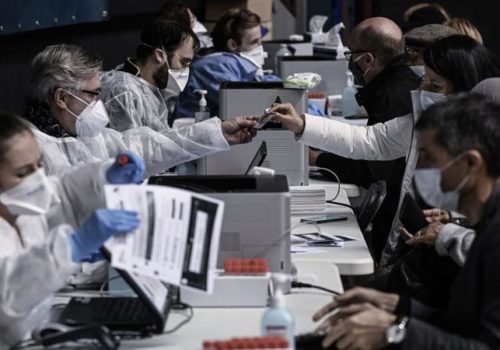
France has introduced curfews in major cities and other European nations are closing schools, bars and restaurants and cancelling operations as authorities battle a second wave of Covid-19 at the onset of winter. Health workers speak to people prior to being tested for Covid-19 at Lyon's sports arena Palais des Sports, which has been turned into a huge testing centre, Photo: AFP See all RNZ coverage of Covid-19 French President Emmanuel Macron announced that people must stay indoors from 11pm to 6am in Paris and eight other cities. The curfew will come into effect from Saturday and last for at least four weeks, Macron said in a televised interview. A state of emergency has also been declared. A further 22,951 infections were confirmed on Wednesday. A partial lockdown comes into force in the Netherlands at 11pm local time and cafes and restaurants are closing. Spain's north-eastern region of Catalonia said that bars and restaurants will close for 15 days from Thursday. European infections have been running at an average of almost 100,000 a day - about a third of the global total. The United Kingdom, France, Russia and Spain accounted for more than half of Europe's new cases in the week to 11 October, according to the World Health Organisation. Europe has by a wide margin overtaken the United States, where more than 51,000 Covid-19 infections are reported on average every day. While 22 states have so far in October set records for increases in new cases, deaths are trending downward and have averaged 700 a day over the last week. Most European governments eased lockdowns over the summer to start reviving economies already battered by the pandemic's first wave. Hand sanitiser on the bar of a restaurant in Paris where a four-week overnight curfew has been announced to fight the rapid spread of Covid-19. 14 October 2020. Photo: AFP But the return of normal activity - from packed restaurants to new university terms - fuelled a sharp spike in cases all over the continent. Bars and pubs were among the first to shut or face earlier closing in the new lockdowns, but now the surging infection rates are also testing governments' resolve to keep schools and non-Covid-19 medical care going. The Czech Republic, with Europe's worst rate per capita, has shifted schools to distance learning and plans to call up thousands of medical students. Hospitals are cutting non-urgent medical procedures to free up beds. "Sometimes we are at the edge of crying," said Lenka Krejcova, a head nurse at Slany hospital near Prague, as builders hurried to turn a general ward into a Covid-19 department. Poland is ramping up training for nurses and considering creating military field hospitals, Moscow is to move many students to online learning, and Northern Ireland is closing schools for two weeks and restaurants for four. "I don't have any good information. We are on the brink of disaster," said immunologist Pawel Grzesiowski in Poland, which reported a record 6,526 infections and 116 deaths on Wednesday. Major European economies such as Germany, England and France have so far resisted pressure to close schools, but in Germany, politicians are debating whether to extend the Christmas-New Year school break to reduce contagion. The Netherlands' return to partial lockdown has not included shutting schools. In Lisbon, football fans were unsurprised after Portugal captain Cristiano Ronaldo tested positive, saying it simply showed everyone was at risk of getting infected - and famous athletes were no exception. Even Pope Francis was subject to new coronavirus rules, staying at a safe distance from well-wishers at his weekly audience on Wednesday. British Prime Minister Boris Johnson faces opposition calls for another national lockdown in England, but has so far resisted. Hospital admissions, however, are climbing and field hospitals constructed in the spring are once more being readied. In Belgium, with Europe's second worst infection rate per capita, hospitals must now reserve a quarter of their beds for Covid-19 patients. - Reuters / BBC
Continue Reading

Thai protests: Thousands gather in Bangkok as king returns to country

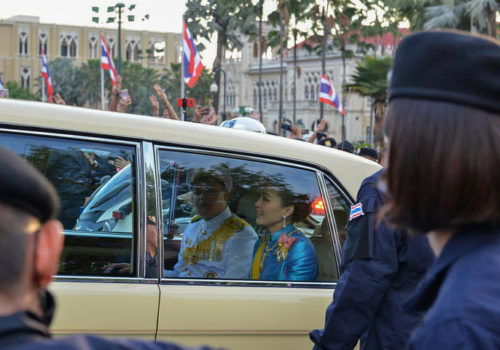
Pro-democracy protesters in Thailand have confronted a motorcade carrying King Maha Vajiralongkorn as it passed through a rally in Bangkok. The protesters, who were pushed back by ranks of police, raised the three-finger salute that has become a symbol of the protest movement. They have called for curbs on the king's powers and for the resignation of Prime Minister Prayuth Chan-ocha. The protests on Wednesday follow months of escalating tension in the country. The king, who spends most of his time abroad but has returned from Germany for several weeks, travelled in a car alongside Queen Suthida through a crowd of peaceful protesters, who chanted and raised their hands in the three-finger salute. The gesture is thought to have been inspired by the Hunger Games films in which it is used as a symbol of unity and defiance. The royal couple were on their way to a Buddhist ceremony on Ratchadamnoen Avenue, where demonstrations had taken place earlier in the day, before the protesters moved on towards Government House. The protesters had vowed not to block the royal motorcade's passage and they did not. Thailand's Queen Suthida and Prince Dipangkorn Rasmijoti in the motorcade as anti-government protesters (back) hold up their three-finger salute. Photo: AFP Supporters of the monarchy, dressed in t-shirts in royal yellow colour, staged rival protests in the capital, with some filmed violently attacking the pro-democracy protesters. Some witnesses accused the government of disguising police as royalist demonstrators. The two sides gathered separately along Ratchadamnoen Avenue on Wednesday afternoon and were kept largely apart by police. The anti-government protesters linked arms and marched chanting "Prayuth, get out!" - referring to the prime minister - and "Long live the people!" The protesters were prevented from reaching Government House by what appeared to be ranks of royalist supporters wearing yellow t-shirts who linked arms and shouted insults at the protesters. "We want to show that we love the king," 47-year-old Sirilak Kasemsawat told AFP news agency, accusing the pro-democracy movement of wanting to "overthrow" the monarchy - a charge the movement has always denied. "We're not asking them to be toppled, forgotten, or not to be respected," said Dear Thatcha, a pro-democracy protester. "We're just asking them to change with us. Our country needs to adapt to many things, and the monarchy is one of the issues that needs to be adapted as well," she said. The growing student-led protest movement, which began in July, has become the greatest challenge in years to Thailand's ruling establishment. Protests over the weekend in the capital were some of the largest in years, with thousands defying authorities to gather and demand change. The protesters' calls for royal reform are particularly sensitive in Thailand, where criticism of the monarchy is punishable by long prison sentences. Pro-democracy protesters walk towards Government House, as people dressed in pro-monarchy yellow t-shirts look on. Photo: AFP / Anadolu Agency Why are there protests? Thailand has a long history of political unrest and protest, but a new wave began in February after a court ordered a fledgling pro-democracy opposition party to dissolve. The Future Forward Party (FFP) had proved particularly popular with young, first-time voters and garnered the third-largest share of parliamentary seats in the March 2019 election, which was won by the incumbent military leadership. Protests were re-energised in June when prominent pro-democracy activist Wanchalearm Satsaksit went missing in Cambodia, where he had been in exile since the 2014 military coup. His whereabouts remain unknown and protesters accuse the Thai state of orchestrating his kidnapping - something the police and government have denied. Since July there have been regular student-led street protests. Demonstrators have demanded that the government headed by Prime Minister Prayuth, a former army chief who seized power in the coup, be dissolved; that the constitution be rewritten; that the authorities stop harassing critics. - BBC
Continue Reading

Govt project on the Cook Islands' Penrhyn to be investigated

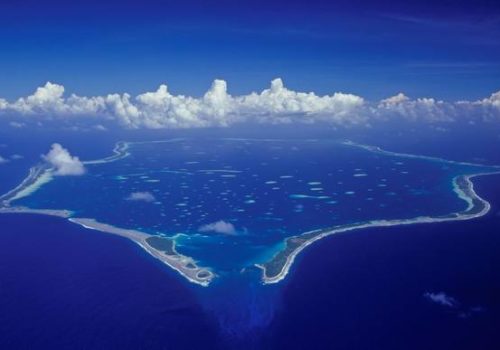
An investigation by the Cook Islands financial watchdog is currently underway into a major government contract for the island of Penrhyn that was tendered earlier this year. Penrhyn in the Cook Islands Photo: Ewan Smith Tenders for the Infrastructure Ministry contract closed in February. The Public Expenditure Review Committee and Audit was looking into the contract which was awarded to Civil Contractors Ltd., a company which was registered in 2019. The contract was to construct two-story cyclone centres on Omoka and Te Tautua villages in Penrhyn. According to the tender, the contract also included all associated building services, including water and waste systems, electrical, communications, plumbing and furnishings. Scrutiny was being placed on how the contract was awarded, possible conflicts of interest and the claim significant payments had already been made to the contractor before the commencement of any work. The committee's reports have to be tabled with parliament before being publicly released although parliament was no longer required to be in session to deal with such reports. Penrhyn, Cook Islands Photo: RNZI / Mary Baines
Continue Reading

NSW confirms 14 new Covid-19 cases, most locally acquired

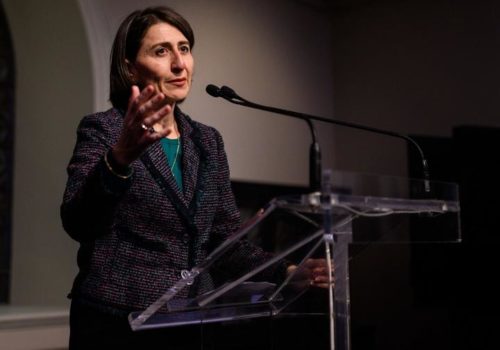
NSW Premier Gladys Berejiklian has warned her state is "on the verge" of another seeding event which saw a surge in coronavirus cases across Sydney. New South Wales Premier Gladys Berejiklian. Photo: AFP Health authorities in NSW confirmed 14 new coronavirus infections in the 24 hours to 8pm yesterday. Eleven of those are locally acquired, and all have been traced back to known clusters or cases. Three cases of coronavirus were identified within hotel quarantine, health authorities said. Berejiklian said the state was "on the verge of being where it was" in early July, when an infected Victorian man sparked a cluster of cases at the Crossroads Hotel in Sydney's south-west. "I cannot stress enough that this is the most concerned we've been since that first incident when the Victorian citizen came up, infected his colleagues and went for a drink at a hotel," Berejiklian said. Nine of the cases are linked to the Lakemba GP cluster, and the other two are linked to the Liverpool Hospital cluster. That brings the Lakemba GP total cluster number to 12, while the source of the cluster is unknown. Two of today's confirmed cases were linked to a private clinic cluster in Liverpool, bringing that total cluster number to 10. One additional case was confirmed outside yesterday's reporting period, found in Bargo, 100km south-west of Sydney. Berejiklian said the location of the additional infection falling beyond the fringe of Sydney, was concerning. NSW chief health officer Kerry Chant said the elderly man in Bargo was still being interviewed to determine the source of his infection. Berejiklian said her government had intended to further ease restrictions in the wake of yesterday's loosening of rules in hospitality and dining. "But we will be holding off until Dr Chant gives us the green light to say we are over the existing current concerns." Berejiklian confirmed the easing of social-distancing restrictions on outdoor dining and events announced yesterday would go ahead. But she said further changes to the amount of patrons in a group booking, as well as capacity limits for small venues and weddings, were all on hold. More than 16,000 people came forward for coronavirus testing yesterday, but Berejiklian said that was "not enough under the existing circumstances". - ABC
Continue Reading

Covid-19: Eli Lilly antibody trial paused due to potential safety concern

Drugmaker Eli Lilly has paused a US government-sponsored clinical trial of its Covid-19 antibody treatment has been paused because of a safety concern. Photo: AFP The drug is similar to the Regeneron Pharmaceuticals treatment President Donald Trump received after he contracted Covid-19. "Out of an abundance of caution, the ACTIV-3 independent data safety monitoring board (DSMB) has recommended a pause in enrolment," an Eli Lilly spokeperson said. "Lilly is supportive of the decision by the independent DSMB to cautiously ensure the safety of the patients participating in this study." Lilly had already asked US regulators to authorise its antibody therapy, LY-CoV555, for emergency use after publishing data in September showing it helped cut hospitalization and emergency room visits for COVID-19 patients. The treatment is being developed with Canadian biotech AbCellera. Safety panel reviews illness that led to J&J vaccine trial pause Johnson & Johnson said it would take at least a few days for an independent safety panel to evaluate an unexplained illness of a study participant that led to a pause in the company's Covid-19 vaccine trial. Rival AstraZeneca's US trial for its coronavirus vaccine candidate - which uses a similar technology - has remained on hold for more than a month after a participant in the company's UK trial fell ill. J&J said the illness was being reviewed by an independent data and safety monitoring board as well as by its own clinical and safety team. The data board, which is also reviewing AstraZeneca's US trial, is required to submit its findings to the US Food and Drug Administration before the study can be restarted. Mathai Mammen, head of research & development at J&J's drugs business, said it would be "a few days at minimum for the right set of information to be gathered and evaluated". He said because the study is blinded, the company did not yet know if the ill person had been given the vaccine or a placebo. Mammen added that J&J remains on track to complete recruitment for its 60,000-person trial in the next two to three months. The company said such pauses are not unusual in large trials. It noted that the voluntary "study pause" in giving doses of the vaccine candidate to trial participants was different from a "regulatory hold" imposed by health authorities. J&J has said it expects to have enough data to apply for US regulatory clearance by the end of the year. Pfizer Inc and Moderna Inc have said they expect to be able to apply for FDA clearance for their vaccine candidates even sooner. Health experts have voiced concerns that U.S. President Donald Trump could put pressure on the FDA and drugmakers to rush an unsafe vaccine to market to bolster his re-election prospect. He has repeatedly said a vaccine could be available prior to the Nov. 3 election. AstraZeneca last month paused late-stage trials of its experimental coronavirus vaccine developed with the University of Oxford due to a serious unexplained illness in a British study participant. While AstraZeneca's trials in Britain, Brazil, South Africa and India have since resumed, its US trial remains on hold. The J&J and AstraZeneca vaccines both use modified, harmless - although different - versions of adenoviruses to deliver genetic instructions to human cells in order to spur an immune response to the target virus, in this case the novel coronavirus. - Reuters
Continue Reading

'I have failed': Kim Jong Un shows tearful side in confronting North Korea's hardships

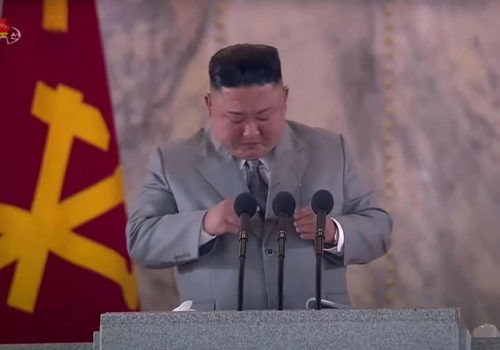
North Korean leader Kim Jong Un appeared to shed tears at the weekend as he thanked citizens for their sacrifices. North Korean leader Kim Jong Un, as seen from a KCTV broadcast on October 10, 2020, pausing as he makes a speech prior to a military parade on Kim Il Sung square in Pyongyang. Photo: STR / KCTV / AFP Though the young leader has consolidated his rule over the isolated nation with ruthless purges, North Korea watchers say he has also sought to portray himself as a more traditional political leader than his eccentric father, Kim Jong Il. Speaking at a military parade on Saturday, Kim became emotional as he paid tribute to troops for their response to national disasters and preventing a coronavirus outbreak and apologised to citizens for failing to raise living standards. "Kim's modesty and candour, and his tears and choking, were all highly unusual, even for someone who publicly acknowledges shortcomings and has an established pattern of being expressive," said Rachel Minyoung Lee, an independent researcher and former open-source North Korea analyst for the US government. The speech, which was clearly carefully designed to resonate with the domestic audience, likely cemented Kim's image as a competent, charismatic leader who also has a human side to him, she said. 'I am sorry' Kim - who broke into wide smiles when huge new ballistic missiles were displayed in the parade - blamed North Korea's continuing economic hardships on international sanctions, the coronavirus crisis and a series of damaging typhoons and floods. Since succeeding his father in 2011, Kim has made economic progress a cornerstone of his agenda. He also met with US President Donald Trump, forming an unprecedented personal relationship that included flowery letters. But ambitious plans for international trade, construction projects, and other economic measures have stalled in the face of sanctions imposed over his nuclear weapons and ballistic missile programmes. The economy took a further hit when North Korea closed its borders to nearly all traffic due to the pandemic, and summer typhoons caused flooding that further threatened food supplies. "Our people have placed trust, as high as sky and as deep as sea, on me, but I have failed to always live up to it satisfactorily," Kim said, at one point appearing to choke up. "I am really sorry for that." Kim said the country's success in preventing a coronavirus outbreak and overcoming other challenges was a "great victory achieved" by the citizens. "Our people have always been grateful to our Party, but it is none other than themselves who surely deserve a bow of gratitude," he said. So much focus on citizens was a major departure for such events, where speeches are usually filled with more ideological themes and lauding of the ruling Workers' Party of Korea, said Lee. "The speech was clearly intended to be for and about the people," she said. Personal approach In contrast to his remote father, Kim has taken his wife to political summits with foreign leaders, often stoops to hug children and mingles with workers at public appearances. Some of this folksy approach has shaped his public response to the country's economic challenges, said Benjamin Katzeff Silberstein, a North Korean economy expert at the US-based Stimson Center think-tank. "Kim has been more personally present and visible at disaster reconstruction sites and the like, and he's prioritised a lot of the symbolic construction projects designed to show economic progress," he said. But despite some early moves towards embracing markets, Kim is not an out-an-out reformer and his policy prescriptions have tended to draw on the North Korea playbook honed by his father and grandfather, state founder Kim Il Sung, Silberstein said. The United Nations says that, under Kim, North Korea has continued to quash basic freedoms, maintaining political prison camps and strict surveillance of its citizens. Kim had his uncle executed, according to state media, and the United States accused his government of using the chemical warfare agent VX assassinate his half-brother, Kim Jong Nam, in 2017, an allegation Pyongyang has denied. Last week Kim called on his country to embark on an 80-day "speed battle" - a campaign to attain economic goals before a congress in January to decide a new five-year plan. Such campaigns, which involve citizens performing "voluntary" extra labour, have been described by some residents as "one of the most exhausting, irritating parts of everyday life", Silberstein said. -Reuters
Continue Reading

German ship completes historic Arctic expedition

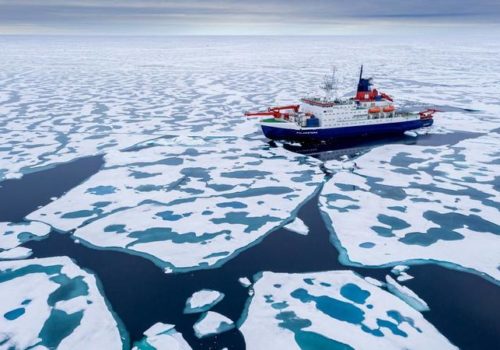
The German Research Vessel Polarstern has sailed back into its home port after completing a remarkable expedition to the Arctic Ocean. Heading for the new MOSAiC ice floe, Polarstern takes the shortest way to the area of interest: via the North Pole. Photo: Alfred-Wegener-Institut / Steffen Graupner The ship spent a year in the polar north, much of it with its engines turned off so it could simply drift in the sea-ice. The point was to study the Arctic climate and how it is changing. And expedition leader professor Markus Rex returned with a warning. "The sea-ice is dying," he said. "The region is at risk. We were able to witness how the ice disappears and in areas where there should have been ice that was many metres thick, and even at the North Pole - that ice was gone," the Alfred Wegener Institute scientist told a media conference in Bremerhaven on Monday. RV Polarstern was on station to document this summer's floes shrink to their second lowest ever extent in the modern era. Welcome home #Polarstern! After more than a year in the Arctic, the ship arrived in Bremerhaven today. The largest expedition to the Arctic so far consisted of over 20 countries. Why? We need more knowledge on climate change. @MOSAiCArctic #MultilateralismMatters pic.twitter.com/vEDZYqhWLW — GermanForeignOffice (@GermanyDiplo) October 12, 2020 The floating ice withdrew to just under 3.74 million sq km (1.44 million sq miles). The only time this minimum has been beaten in the age of satellites was 2012, when the pack ice was reduced to 3.41 million sq km. The downward trend is about 13 percent per decade, averaged across the month of September. "This reflects the warming of the Arctic," Rex said. "The ice is disappearing and if in a few decades we have an ice-free Arctic - this will have a major impact on the climate around the world." Polar bear mom and cub visit the ice floe. Photo: MOSAiC / Esther Horvath The €130m (£120m/$150m) cruise set off from Tromsø, Norway, on 20 September last year. The project was named the Multidisciplinary drifting Observatory for the Study of Arctic Climate (MOSAiC). The idea was to recreate the historic voyage of Norwegian polar researcher Fridtjof Nansen, who undertook the first ice drift through the Arctic Ocean more than 125 years ago. RV Polarstern embedded itself in the ice on the Siberian side of the Arctic basin with the intention of floating across the top of the world and emerging from the floes just east of Greenland. In the course of this drift, hundreds of researchers came aboard to study the region's environment. They deployed a battery of instruments to try to understand precisely how the ocean and atmosphere are responding to the warming forced on the Arctic by the global increase in greenhouse gases. AWI sea-ice physicists are working on the sea ice, while the wind is accelerating and the snow drift is increasing. Photo: MOSAiC / Stefan Hendricks Coronavirus only briefly interrupted the expedition - not by making participants ill, but by obliging the ship at one point to leave the floes to go pick up its next rotation of scientists. Other ships and planes were supposed to deliver the participants direct to RV Polarstern, but international movement restrictions made this extremely challenging in the early-to-middle part of this year. Despite the hiatus, Rex declared the MOSAiC project a huge success. The mass of data and samples now in the possession of researchers would make the modelling they use to project future climate change much more robust, he explained. It was as if the MOSAiC scientists had been shown the inner workings of an intricate clock, he said. "We looked at all the different elements, down to the different screws of this Arctic system. And now we understand the entire clockwork better than ever before. And maybe we can rebuild this Arctic system on a computer model," he told reporters. -BBC
Continue Reading

Cardinal George Pell meets Pope Francis for first time since acquittal

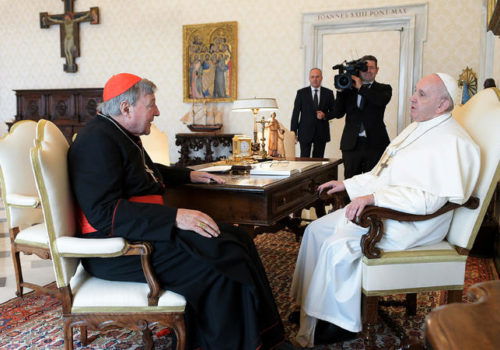
Cardinal George Pell has met Pope Francis in Rome for the first time since the Australian cardinal's conviction for child sexual abuse was overturned. Pope Francis talks with Cardinal George Pell Photo: VATICAN MEDIA via AFP The pair met in a private audience but the Holy See gave no further details. The Vatican ex-treasurer, 79, was the most senior Catholic figure ever jailed for such crimes but the conviction and six-year term were quashed in April. Pell, who had served a year in jail, said his meeting with the Pope "went very well". It is unclear whether he will take another role in the Holy See. The cardinal, who always maintained his innocence, had left the Vatican in 2017 to fight the charges against him in his home state of Victoria. His case had rocked the Catholic Church, where he had been one of the Pope's most senior advisers. The cardinal has maintained a low profile in Sydney, where he was once archbishop, in the months since the High Court of Australia overturned the conviction. A jury in December 2018 had found him guilty of sexually abusing two 13-year-old choir boys in St Patrick's Cathedral in the mid-90s when Archbishop of Melbourne. The High Court ruled the jury had not properly considered all the evidence. Pell had been granted an exemption to leave Australia, which closed its borders in March to incoming and outgoing citizens due to the coronavirus pandemic. His return to Rome comes during a tumultuous period for the Vatican. Last month, Pope Francis fired senior cleric Cardinal Giovanni Angelo Becciu over embezzlement accusations. Becciu and Pell had clashed over financial reforms. Pell said of the sacking: "The Holy Father was elected to clean up Vatican finances. He plays a long game and is to be thanked and congratulated on recent developments." - BBC
Continue Reading

Threats to freedom warned if social media unlocked to Five Eyes

Civil liberties groups believe privacy, freedom of expression and trade secrets could be eroded if tech companies give up their encrypted data to governments. Photo: 123RF The New Zealand Government and its Five Eyes security partners are calling on companies like Facebook to release data when requested, in order to curb online crime. Minister for Justice Andrew Little said while encryption played an important role in protecting personal data it was also used to hide illicit material such as child pornography or terror communication. Little - who oversees New Zealand's spy agencies - said instances of child sexual abuse and exploitation online were growing rapidly. To curb this, the government wants to cooperate with tech companies. And that would include requests for information being on a warranted basis. "Government's would demonstrate there is a reasonable cause to suspect there has been criminal offending, so the control is still left in the platform owners, but it gives enforcement authorities the ability to chase up and investigate some of the most heinous criminal offending we've ever seen." But Council of Civil Liberties chair Thomas Beagle pans the government's plea for more access as contradictory and dangerous. "It talks about the value of encryption - secure information, private conversations, doing things free from repressive governments - and then it talks about how they need to stop all that because they need to access it to stop crime." Even if a New Zealand government handled the information carefully, that doesn't mean other countries will. And if one government has access to this information, then other government's will request it as part of doing business with another country, Beagle said. He warns that surveillance has a chilling effect on freedom of expression and association. "Our government already has extensive powers of surveillance using other means, and I don't believe this will be the silver bullet that will stop all this crime happening." Privacy Commissioner John Edwards. Photo: Supplied / Office of the Privacy Commissioner Privacy Commissioner John Edwards said agencies could already be required to hand over information if there was a lawful warrant. "Government's are quite right to be concerned about the use of platforms for exploitation of children, the difficulty is in how you provide that access in a way that does not break the security for legitimate purposes." He said requirements for companies to release information would be applied in all countries, including oppressive ones. An international set of guidelines could be established to set out how information is gathered, he suggested, but added that would not be water tight. "Even then you don't solve the technical challenge of allowing access for legitimate purposes while maintaining a secure network, and people in the tech industry tell me this is impossible." Karaitiana Taiuru. Photo: Supplied Cultural advisor and advocate for digital Māori rights, Karaitiana Taiuru, said shutting down harmful behaviour on platforms like Facebook could actually help Māori who face online racism, abuse and scams. It was often not reported because there were no culturally sensitive systems or agencies equipped to deal with complaints, he said. Taiuru said added protection for vulnerable or young Māori was good, but only if Māori voices were at the table helping set the terms. "We've got several hundred years of mistrust with the government." He cited the Tohunga Suppression Act 1907, the Native Schools Act 1867, the Urewera Raids as examples of improper surveillance and suppression against Māori. "The primary issues with all of those significant pieces of legislation that did impact Māori, was that there was no consultation with Māori or with the appropriate individuals and organisations." The more pressing concern for surveillance of Māori is facial recognition technology, Taiuru said.
Continue Reading

Facebook bans Holocaust denial content

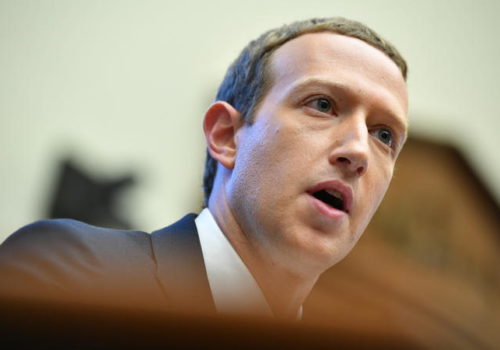
Facebook has explicitly banned Holocaust denial for the first time as boss Mark Zuckerberg says his "thinking has evolved". Facebook boss Mark Zuckerberg Photo: AFP The social network said its new policy prohibits "any content that denies or distorts the Holocaust". Facebook boss Mark Zuckerberg wrote that he had "struggled with the tension" between free speech and banning such posts, but that "this is the right balance". Two years ago, Zuckerberg said that such posts should not automatically be taken down for "getting it wrong". "I'm Jewish and there's a set of people who deny that the Holocaust happened," he told Recode at the time. "I find it deeply offensive. But at the end of the day, I don't believe that our platform should take that down because I think there are things that different people get wrong. I don't think that they're intentionally getting it wrong." His remarks led to a large public backlash. But on Monday, as Facebook changed its policies, he wrote that he had changed his mind. "My own thinking has evolved as I've seen data showing an increase in anti-Semitic violence, as have our wider policies on hate speech," he wrote in a public Facebook post. "Drawing the right lines between what is and isn't acceptable speech isn't straightforward, but with the current state of the world, I believe this is the right balance." Earlier this year, Facebook banned hate speech involving harmful stereotypes, including anti-Semitic content. But Holocaust denial had not been banned. Facebook's vice-president of content policy, Monika Bickert, said the company had made the decision alongside "the well-documented rise in anti-Semitism globally and the alarming level of ignorance about the Holocaust, especially among young people". She said that later this year, searching for the Holocaust - or its denial - on Facebook would direct users to "credible" information. But she also warned change would not happen overnight, and training its employees and automated systems would take time. The World Jewish Congress - which had conferred with Facebook on anti-Semitism - welcomed the move. "Denying the Holocaust, trivialising it, minimising it, is a tool used to spread hatred and false conspiracies about Jews and other minorities," the group said in a statement. But it also noted that it had campaigned for the removal of Holocaust denial content from the platform "for several years". Jonathan Greenblatt, chief executive of the Anti-Defamation League, tweeted: "This has been years in the making. "Having personally engaged with Facebook on the issue, I can attest the ban on Holocaust denial is a big deal ... glad it finally happened." -BBC
Continue Reading
Back To Top