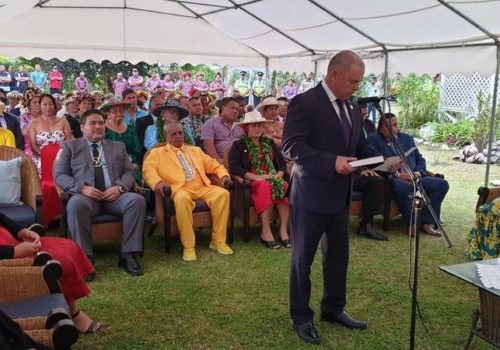
Mark Brown was sworn in as the 12th Prime Minister of the Cook Islands in a ceremony last night.
The new Deputy Prime Minister is Robert Taipatau.
Mark Brown is sworn in as the new Prime Minister of the Cook Islands Photo: Office of the Cook Islands PM
Brown and his cabinet took the Oath of Allegiance and were issued with their warrants during a formal ceremony at Government House conducted by the Queen's Representative, Sir Tom Marsters.
Brown replaces Henry Puna who stood down to contest the Secretary General's role at the Pacific Islands Forum.
Brown, who has spent 10 years in parliament, was educated at Gisborne Boys' High School, Massey University and the University of the South Pacific.
Before entering parliament he worked in the Cook Islands public service and also had business interests there.
In his time as Puna's deputy he was very much the voice of the Cook Islands Party Government.
A Japanese man has pleaded guilty to murdering nine people after contacting them on Twitter, in a high-profile case that has shocked the country.
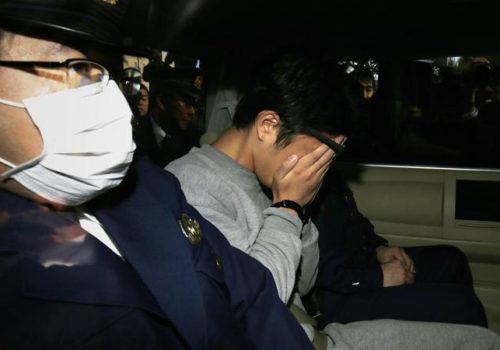
Takahiro Shiraishi (C) covers his face with his hands as he is transported to the prosecutor's office from a police station in Tokyo Photo: AFP
Dubbed the "Twitter killer", Takahiro Shiraishi was arrested in 2017 after body parts were found in his flat.
He told a court in Tokyo on Wednesday that the allegations against him "are all correct".
But his lawyers argue that his charges should be reduced because his victims apparently gave consent to be killed.
If convicted of murder, Shiraishi faces the death penalty, which is carried out by hanging in Japan.
The court case has attracted wide interest, with more than 600 people lining up for 13 public gallery seats to watch the first hearing on Wednesday, reported public broadcaster NHK.
What happened?
The prosecution say the accused opened a Twitter account in March 2017 "to contact women contemplating suicide, whom he saw as easy targets", NHK said.
Eight of his victims were women, one of them aged 15.
The only male victim, aged 20, was killed after confronting Shiraishi about the whereabouts of his girlfriend, Japanese media reported.
The 29-year-old is believed to have lured his victims by telling them he could help them die and in some cases claimed he would kill himself alongside them.
His Twitter profile contained the words: "I want to help people who are really in pain. Please DM [direct message] me anytime."
The serial killings first came to light when police were looking into the disappearance of a young woman, who later turned out to be one of the victims.
Officers visited Shiraishi's flat in the Japanese city of Zama, near Tokyo, where they found dismembered body parts.
What do his lawyers say?
Shiraishi's lawyers argue his victims had agreed to be killed, so the charges should be reduced to "murder with consent". This carries a lower prison sentence of between six months and seven years.
But it is reported that Shiraishi disagrees with his lawyers.
He told Mainichi Shimbun, a local daily, that he killed without the consent of his victims.
"There were bruises on the back of the victims' heads. It means there was no consent and I did it so that they wouldn't resist," he said in comments published on Wednesday.
What impact have the killings had?
The serial killings have stunned Japan. When they were exposed in 2017 it triggered a new debate about websites on which suicide is discussed. At the time the government indicated it may introduce new regulations.
The murders also prompted a change by Twitter, which amended its rules to state users should not "promote or encourage suicide or self-harm".
Twitter's chief executive Jack Dorsey said at the time the case was "extremely" sad.
Japan has long battled one of the highest suicide rates in the industrialised world although figures have dropped since preventative measures were introduced more than a decade ago.
-BBC
A British zoo has had to separate a group of five African Grey parrots because their language was too strong for younger visitors.
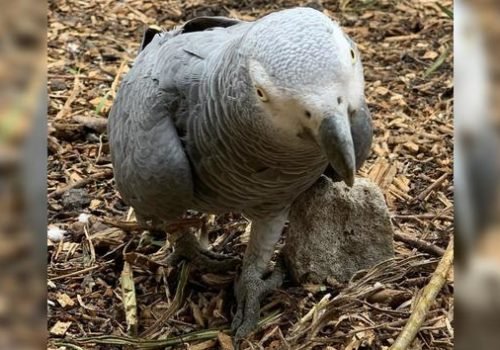
The parrots - named Eric, Jade, Elsie, Tyson and Billy - are residents at the Lincolnshire Wildlife Park having all been rehomed there from different owners.
Park chief executive Steve Nichols told Morning Report the keepers at the park were given a bit of a warning about what they were in for.
He may look cute, but he's got a mean mouth. Photo: Facebook/Lincolnshire Wildlife Park
"They'll turn around and tell you exactly what they like to eat and what their favourite toy is and then just as they fill the form in, you'll get that little quiet voice where they'll turn around, say 'I do apologise, but Billy does actually have a few choice words as well.'"
Swearing parrots aren't exactly new though and Nichols said the staff laughed it off, but he soon discovered the problem was worse than first thought when he found himself working in an office next to the quarantine area.
"I actually thought it was some rowdy keepers that we've got that I thought they were getting a little bit over the top with each other," he said.
"I went in the room to explain to them to stop, just quieten it down a little, and was very shocked when I walked in and there were no people there it was just parrots."
The problem was the parrots were egging each other on. Nichols explained one parrot would swear and another would laugh, then another parrot would swear worse, prompting more laughter from the other parrots.
It was hard for the park's human inhabitants to not join in too.
"It is so difficult not to laugh when you're walking past and one of the parrots just swears, just literally blurts it out. You can't help but laugh, you know, it's just impossible not to."
But for Nichols it soon became a bit personal. The parrots came to recognise him and soon came up with their own nickname for him.
"When I walk past they'll shout 'oi you fat tw*t' and it's like, 'I've just lost two stone that's very nice, why are you saying that?"
On top of that it was becoming a problem for the park's visitors.
"We can't really have it for the children," Nichols said.
"It's not very nice when the children are going back to nanny and asking what this word is that this parrot said."
The group have all been moved to different parts of the park where they can't talk to each other and cause problems.
President Trump mentioned a far-right group during the first presidential debate, kicking off online celebrations by its supporters.
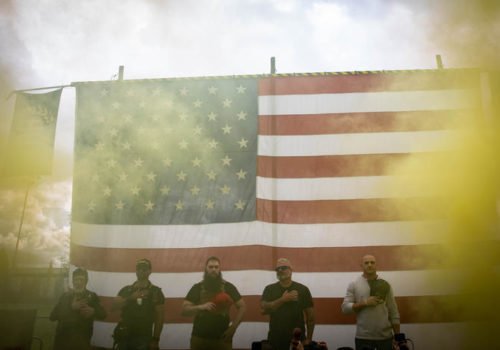
Yellow smoke fills the air as an American flag is raised at the start of a Proud Boys rally at Delta Park in Portland, Oregon on September 26, 2020. Photo: AFP / Maranie R Staab
"Proud Boys - stand back and stand by," he said, in a response to a question asking him to condemn white supremacist and militia groups. Members of the group online took the answer as a call to prepare for action.
Trump then insisted that violence was coming from far-left activists: "Somebody's got to do something about antifa and the left, because this is not a right-wing problem."
Joe Biden, the Democratic challenger, answered back: "Antifa is an idea, not an organisation. That is what [President Trump's] FBI director said."
Over the past few years, a number of fringe groups have been engaged in politically motivated violence on American streets. So who are Proud Boys and antifa?
Proud Boys
Founded in 2016 by Canadian-British right-wing activist Gavin McInnes, the Proud Boys is a far-right, anti-immigrant, all-male group with a history of street violence against its left-wing opponents.
The group's name is a reference to a song from the musical version of the Disney film Aladdin. Members often wear black and yellow Fred Perry polo shirts along with red "Make America Great Again" hats.
A Proud Boy must declare that he is "a Western chauvinist who refuses to apologise for creating the modern world".
Their platform, such as it is, includes Trumpian ideas ("glorify the entrepreneur", "close the border") libertarianism ("give everyone a gun", "end welfare") and traditional gender roles ("venerate the housewife").
They're not exclusively white - yet have became notorious for violent political confrontations.
The Proud Boys and affiliated groups have faced off against antifa in a number of violent street rallies in the last two years, most notably in Oregon, Washington and New York. Two members were jailed last year for beating up antifa activists in New York.
Facebook, Instagram, Twitter and YouTube have all banned the group from their platforms, and members and official chapters have been largely shunted towards less-popular networks.
Enrique Tarrio, the group's current chair, reacted to the debate on the alternative discussion network Parler: "Standing by sir.... I will stand down sir!!!"
Leaders of the Proud Boys, a right-wing pro-Trump group, Enrique Tarrio (right) and Joe Biggs (left) embrace each other as the Proud boys members gather with their allies in a rally called "End Domestic Terrorism" against Antifa in Portland, Oregon on 26 September, 2020. Photo: AFP / John Rudoff / Anadolu Agency
Founder Gavin McInnes publicly disassociated himself from the group in 2018, saying that he was taking the advice of his legal team.
But in a video reacting to Tuesday's debate, he said (albeit not seeming entirely serious): "I control the Proud Boys, Donald. Do not stand down, do not stand back."
On the chat app Telegram, Proud Boys shared the debate clip along with posts taunting antifa and incorporating the phrase "stand back, stand by" into the group's logo.
Meanwhile, critics of the president loudly condemned him.
Antifa
Antifa, short for "anti-fascist", is a loose affiliation of mostly far-left activists.
They include anarchists, but also communists and a few social democrats. What sets them apart is their willingness to use violence - in self-defence, they say.
The movement, which at one point almost entirely disappeared in the US, saw a surge of interest after the election of Donald Trump. They routinely clash with the far right.
The group has been prominent during Black Lives Matter protests in many major cities, and have been particularly associated with unrest in Portland, Oregon.
A man holds an anti-fascism flag as hundreds of demonstrators gather and march to the City Public Safety Building over Daniel Prude's death in Rochester, New York, United States on September 6, 2020. Photo: AFP / Tayfun Coskun / Anadolu Agency
In late August, a self-described anti-fascist, 48-year-old Michael Reinoehl, shot and killed a supporter of Patriot Prayer, a Portland-area group that often marches with the Proud Boys.
Reinoehl was shot dead by police the following week.
Both groups are relatively small - and can count on, at the most, a few thousand active supporters. But their propensity for violence, particularly when they confront each other on American streets, has made them a much bigger topic of conversation than those numbers suggest.
-BBC
The Australian government will pump close to $A1.5 billion into the manufacturing sector, outlining plans to shore up local production and strengthen supply chains in the wake of Covid-19.
The Australian government's investment will prioritise medicines and medical products. Photo: AFP / Sigrid Gombert / Cultura Creative
Under the manufacturing strategy unveiled on Wednesday, $A107 million will be dedicated to strengthening supply lines for essential goods.
That money will prioritise medicines and medical products, with the goal of boosting Australia's ability to provide critical supplies for itself during surges in demand.
A separate $A1.3b will spent over the next four years, starting in the first half of 2021, to help manufacturers upscale their businesses, with additional focus on turning concepts into finished products, and integrating into global supply chains.
The money will be distributed to businesses willing to co-invest with the government in six priority areas:
Resources technology and critical minerals
Food and beverages
Medical products
Recycling and clean energy
Defence
Space
In addition, $A52m will be spent on a second round of the government's manufacturing modernisation fund.
Australia's PM says manufacturing jobs changing
Recent research from the The Australia Institute's Centre for Future Work ranked Australia lowest among OECD countries in terms of manufacturing self-sufficiency.
Industry Minister Karen Andrews said the government and industry had learned lessons from the Covid-19 pandemic.
"Our manufacturers have risen to the challenge to deliver during Covid-19 and now we're unlocking their potential to deliver for our future," she said.
"By playing to our strengths, strategically investing and boosting the role of science and technology in industry, we can open up new markets and take more of our quality products to the world."
Prime Minister Scott Morrison will outline more details of the plan in a pre-budget speech at the National Press Club, where he will say manufacturing jobs are increasingly being created away from the assembly line, the ABC reports.
"Today's advanced manufacturing enterprise stretches from the labs doing the research and development, the skilled workers doing the design and engineering, through to sales, marketing and after-sale services," his speech says.
"Increasingly, this is where most of the value is created - around half of the jobs in manufacturing are in these parts of the manufacturing process."
Morrison will say the government plans to work with industry over the next six months to develop road maps for each of the priority manufacturing areas targeted by the government.
"The roadmaps will set clear goals and performance indicators - such as jobs, R&D and investment - over the next two, five and 10 years," he will say.
- ABC
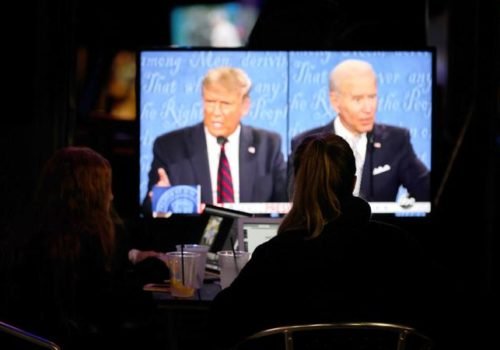
US voters have endured the first of three presidential debates between President Donald Trump and Joe Biden.
People watch the first presidential debate between President Donald Trump and Joe Biden. Photo: AFP
The event has also prompted a huge reaction from world audiences who tuned in for the chaotic event.
Newspapers and commentators around the world have criticised the tone and tactics of the debate.
As The Times in the UK wrote, "The clearest loser from the first presidential debate between Donald Trump and Joe Biden was America."
[UK]
The paper went further, saying the event "was not a debate in any meaningful sense" but rather "an ill-tempered and at times incomprehensible squabble between two angry septuagenarians who palpably loathe each other".
The Guardian described it as a "national humiliation".
"The rest of the world - and future historians - will presumably look at it and weep," the paper wrote, adding that Mr Biden was the only man who looked "remotely presidential" on the stage and saying that if Trump was re-elected in November, "this dark, horrifying, unwatchable fever dream will surely be the first line of America's obituary."
The Financial Times highlighted how the president had stoked lies about voter fraud and urged his supporters to carefully watch polling stations. "'Dog-whistling' is the politico-speak for such language, but it implies subtlety. Mr Trump was blatant," it wrote.
The paper also noted that snap polls after the event said Biden had come out on top. "But no one with a care for American democracy can have switched off feeling anything but queasy."
France
"Chaotic, childish, gruelling" - that's how French newspaper Libération described Wednesday's debate. Le Monde agreed, calling it a "terrible storm", and saying that the president had sought to "push his opponent off his hinges" with constant interruptions and by mocking his answers.
Le Figaro said Biden had "systematically refused to play his opponent's game". While Trump tried to directly confront his challenger, pointing at him and addressing him directly, the Democratic candidate spoke more to viewers and looked directly into the camera.
"Trump voters are unlikely to have had any doubts about their candidate, despite an unconvincing performance. Those of Biden, on the other hand, had confirmation that the Democrat was able to measure up to his formidable opponent, and even put him on the defensive," the paper wrote.
Germany
Der Spiegel's analysis of the debate is headlined "A TV duel like a car accident".
In a piece titled Part fist-fight, part play, Süddeutsche Zeitung wrote: "Both Trump and Biden could go home satisfied because as far as the theatrical performance is concerned, both did their job properly. Donald Trump played Donald Trump, Joe Biden played Joe Biden, and fans should have liked it."
Die Welt said the debate had revealed very little about policy. "Most importantly, it showed that America has a president whose behaviour stands out and who lacks self-control - but that's not exactly news," it wrote.
Biden in contrast was not an exciting candidate but "at least someone with common sense and a stable personality" who would "bring something like normalcy back to the White House".
Italy
"Never had American politics sunk so low," La Repubblica's US correspondent wrote, describing the debate as "Chaotic, rowdy, and based on mutual contempt".
Il Corriere della Sera meanwhile said President Trump's refusal to condemn white supremacy was "a message for Black America".
Russia
One broadcaster described it as a "one and a half-hour exchange of insults", while another said there was "no constructive dialogue".
"The rivals kept interrupting each other and instead of a balanced discussion they chose the path of mutual insults," pro-Kremlin NTV television said.
Biden's description of President Trump as "Putin's puppy" also generated comments on Russian social media. One Twitter user said: "Two old men are figuring out which of them is more worthy to become the president of the United States, but without Putin, you can't boost your rating."
China
Chinese official media sites broadly ignored the US debate although some wrote about how both candidates had used China to attack their opponent.
The state-run Global Times called it "the most chaotic presidential debate ever" and noted that Mr Trump had taken "aim at China by blaming [it] for the raging Covid-19 epidemic and US economic woes".
Editor-in-chief Hu Xijin wrote on Twitter that the debate reflected "division, anxiety of US society and the accelerating loss of advantages of the US political system".
India
Hindi-language news channel AajTak accused both candidates of "mud-slinging", while broadcaster Times Now said the debate was "marred with personal jibes and political barbs".
But the strongest commentary came from The Times of India, the country's largest-selling English-language newspaper, which compared the debate to "mud-wrestling".
"The US embarrassed itself before the world for 100 minutes," it wrote.
- BBC
Azerbaijan's president has vowed to fight on until Armenian forces leave disputed territory, on the fourth day of fierce fighting in the region.
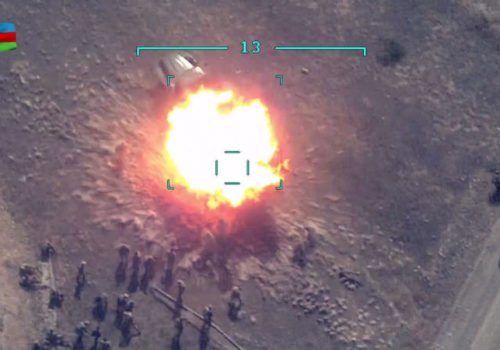
An image grab from a video on the official website of the Azerbaijani Defence Ministry on September 30, 2020, allegedly shows Azeri units destroying Armenian forces during fighting over the breakaway Nagorny Karabakh region. Photo: Handout / Azerbaijani Defence Ministry / AFP
"We only have one condition: Armenian armed forces must unconditionally, fully, and immediately leave our lands," President Ilham Aliyev said.
More than 100 deaths have been reported in the heaviest fighting in years over the Nagorno-Karabakh region. Officially part of Azerbaijan, it is governed by ethnic Armenians.
The two former Soviet republics fought a war in 1988-1994 over the territory. Although Armenia backs the self-declared republic it has never officially recognised it.
It is unclear what caused the renewed fighting, which is the heaviest since the 1994 ceasefire, and there are growing fears international powers could be dragged into the conflict.
On Wednesday French President Emmanuel Macron said he was "extremely concerned by the warlike messages" coming from Turkey, a staunch ally of Azerbaijan.
Turkey says it is "fully ready" to help Azerbaijan recover the enclave.
Meanwhile, Armenia's defence ministry released a picture of an Armenian SU-25 jet it said had been shot down by a Turkish F-16 on Tuesday. Turkey has rejected the allegation as "cheap propaganda" and Azerbaijan says Armenia is lying about the cause.
A handout picture provided by the Armenian Unified Infocenter on September 30, 2020 reportedly shows the remains of an Armenian SU-25 warplane downed during fighting with Azerbaijan over the breakaway Nagorny Karabakh region. Photo: AFP / Armenian Unified Infocenter / handout
And one fighter has told BBC Arabic he was recruited in northern Syria last week and sent via Turkey to fight in the conflict. Ilnur Cevik, an adviser to Turkish President Recep Tayyip Erdogan, dismissed the report as "completely unfounded".
What's happening on the ground?
Dozens of soldiers and some civilians have died since fighting broke out on Sunday.
Both sides accused the other of shelling across the so-called Line of Control, separating forces in Nagorno-Karabakh.
On Wednesday, Azerbaijan published footage of what it said was the destruction of two "enemy" tanks and said an Armenian battalion had fled the area around Tonashen.
Armenian reports said three civilians had been killed in an Azerbaijani air attack on the town of Martakert in Nagorno-Karabakh.
Armenian state news agency Armenpress said seven civilians and 80 service personnel had been killed since the fighting began.
Azerbaijan's prosecutor general announced on Wednesday that 14 civilians had been killed and 46 injured.
BBC Arabic, meanwhile, has spoken to one man who was recruited in northern Syria "to guard military points" on Azerbaijan's borders for $2000 (£1550).
Abdullah - not his real name - said he was flown to Azerbaijan via Istanbul with other Syrian men. They received no training, but were sent to Nagorno-Karabakh "wearing Azerbaijani uniforms" when fighting broke out.
"The car stopped and we were surprised to find ourselves on the front line," he said. "Then the bombing began, people were crying in fear and wanted to go home."
President Erdogan's adviser Ilnur Cervik called the accusation "a kind of disinformation campaign".
"We are not recruiting anyone. Where is the proof that we're recruiting these people along with the Syrian opposition sending them Azerbaijan [sic]? This is completely false," he said.
The Syrian Observatory for Human Rights reports that about 320 Syrian mercenaries have been transported to Azerbaijan by Turkish security companies. But they add that Armenian-born fighters in Syria have also been transported to Armenia to join the fight.
What's the international situation?
On Wednesday French President Macron warned Turkey about "warlike comments... which essentially remove any inhibitions from Azerbaijan in what would be a reconquest of Nagorno-Karabakh. That we will not accept."
Turkey is an ally of Azerbaijan, and even closed its border with Armenia in 1993 in solidarity over the Nagorno-Karabakh dispute.
Macron meanwhile appeared to promise greater support to Armenia in the coming days: "I say to Armenia and to the Armenians, France will play its role."
Hundreds of thousands of French citizens are of Armenian descent. France is also a chair of the Organization for Security and Co-operation in Europe (OSCE) Minsk Group, created in 1992 to resolve the conflict between Armenia and Azerbaijan.
In recent weeks, Nato allies France and Turkey have been on opposite sides in a dispute over energy claims in the Eastern Mediterranean. They have also been at odds over the power struggle in Libya.
Turkey has said it will do "what is necessary" to back Azerbaijan, and Foreign Minister Mevlut Cavusoglu accused the French president of, in effect, supporting occupation.
But there has been international concern that Turkey may back a bigger military operation. Cavusoglu has already said Turkey will support Azerbaijan "both on the field and at the negotiation table" and a presidential aide has spoken of Turkey's commitment "to helping Azerbaijan take back its occupied lands".
Macron said he would speak to Russian President Vladimir Putin later on Wednesday about the conflict.
Russia is part of a military alliance with Armenia, and has a military base in the country. However, it is also close to Azerbaijan's rulers, and has called for an immediate ceasefire, offering to mediate in the conflict.
On Wednesday, Armenian Prime Minister Nikol Pashinyan said he had not yet discussed Russia's possible involvement in the conflict, given their alliance.
"Armenia's armed forces are capable of defending the country's security," he told reporters.
Nagorno-Karabakh - key facts
A mountainous region of about 4400 sq km (1700 sq miles)
Traditionally inhabited by Christian Armenians and Muslim Turks
In Soviet times, it became an autonomous region within the republic of Azerbaijan
Internationally recognised as part of Azerbaijan, but majority of population is ethnic Armenian
Self-proclaimed authorities are not recognised by any UN member, including Armenia
An estimated one million people displaced by war in 1988-94, and about 30,000 killed
Separatist forces captured some extra territory around the enclave in Azerbaijan
Stalemate has largely prevailed since a 1994 ceasefire
Turkey openly supports Azerbaijan
Russia has a military base in Armenia
- BBC
British Prime Minister Boris Johnson has urged residents to obey rules imposed to tackle a rapidly accelerating second wave of the coronavirus outbreak, or risk facing a tougher lockdown.
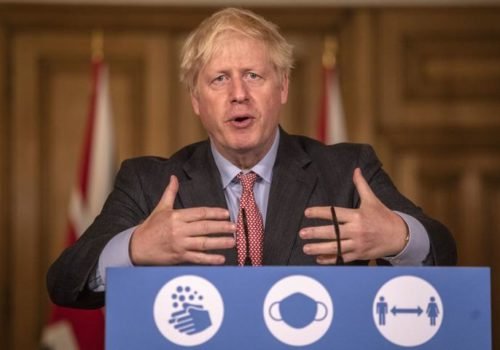
UK Prime Minister Boris Johnson at a media conference as the country faces a rapid acceleration of Covid-19 outbreaks across the country. Photo: AFP
New cases of Covid-19 are rising by more than 7000 per day in the United Kingdom, though Johnson is facing growing opposition to lockdown measures.
After a reprimand from the speaker of parliament's House of Commons, Johnson defused a rebellion among MPs over the way such onerous rules were imposed by promising angry lawmakers more say over any new national measures.
At a briefing in Downing Street flanked by his chief medical and scientific advisers, Johnson acknowledged the opposition to his curbs on freedom.
However he said the British people should follow lockdown rules.
"I know that some people will think we should give up and let the virus take its course despite the huge loss of life that would potentially entail," Johnson said on Wednesday.
"I have to say I profoundly disagree and I don't think it's what the British people want. I don't think they want to throw in the sponge, they want to fight and defeat the virus," he said.
Britain, which has the worst official Covid-19 death toll in Europe, is facing a rapid acceleration of outbreaks across the country, England's Chief Medical Officer Chris Whitty said.
Chief Scientific Adviser Patrick Vallance said the outbreak was not yet under control.
Swathes of the UK and millions of citizens are subject to local restrictions brought in to try to slow the second wave of Covid-19 infections.
Britain has reported more than 42,143 deaths from the virus - the world's fifth- highest total.
"If the evidence requires it, we will not hesitate to take further measures that would, I'm afraid, be more costly than the ones we put into effect now," Johnson said.
Johnson previously had to apologise after getting muddled over local lockdown rules on Tuesday.
He is facing growing anger within his own Conservative Party over the most severe restrictions in peacetime history, which are destroying swathes of the economy.
In a rare intervention by the chief officer of the House of Commons, Speaker Lindsay Hoyle scolded Johnson for making rules in a "totally unsatisfactory" way.
"The way in which the government has exercised its powers to make secondary legislation during this crisis has been totally unsatisfactory," Hoyle told parliament.
After Johnson's government offered concessions, MPs passed the extension of the Coronavirus Act, which hands the government emergency powers to introduce restrictions, voting 330 to 24 in favour.
The UK's economy has shrunk by a record 19.8 per cent in the second quarter of 2020 - meaning it contracted more than any other Group of Seven economy in the first half of 2020.
- Reuters
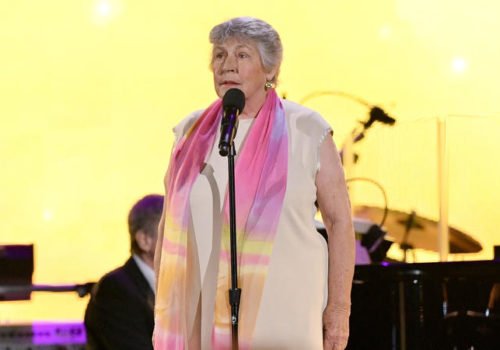
Australian singer Helen Reddy, who reached number 1 around the world with hits like I Am Woman, has died in Los Angeles at the age of 78.
Recording artist Helen Reddy performs onstage during the MPTF 95th anniversary celebration. Photo: AFP
Her family confirmed she died yesterday.
Her song I Am Woman was an anthem for the feminist movement.
"She was a wonderful mother, grandmother and a truly formidable woman," a family statement on her official fan Facebook page said.
"Our hearts are broken. But we take comfort in the knowledge that her voice will live on forever."
US President Donald Trump and Democratic presidential nominee Joe Biden will debate an array of urgent political challenges, including the response to the coronavirus pandemic, the Supreme Court, and continued protests for racial justice.
[embedded content]
The 90-minute debate, with a limited and socially distanced in-person audience because of the pandemic, will begin at 2pm (NZ time) at Case Western Reserve University in Cleveland.
RNZ's Max Towle and Jeremy Rees will bring you the latest developments here:
It is the first of three scheduled debates:
Second presidential debate: Trump and Biden will debate again on 16 October, 2pm (NZT), at a performing arts centre in Miami, Florida. Steve Scully of C-SPAN Networks is set to moderate the debate.
Third presidential debate: In their final chance to win over voters, Trump and Biden will take to the stage in Nashville, Tennessee. NBC's White House correspondent Kristen Welker will be hosting the debate on 23 October, 1pm (NZT).
The only vice presidential debate between Harris and Pence will take place on 8 October, 12pm (NZT) in Salt Lake City, Utah.
White House aides have said Trump, 74, will aggressively challenge Biden's record on issues such as trade, energy and taxes and will be prepared to defend himself on his own taxes.
Trump, who has repeatedly cast doubt on the integrity of the election, is likely to face questions about his refusal to commit to accepting the election results and a peaceful handover of power should he lose.
Biden, 77, is certain to press his criticism of Trump's response to the pandemic, and highlight Trump's efforts to eliminate the Affordable Care Act, the law known as Obamacare which has helped millions of Americans obtain health insurance.
The debate will be divided into six segments - the records of Trump and Biden, the US Supreme Court, the coronavirus pandemic, the economy, election integrity and "race and violence" in US cities.
Ahead of the debate, Democrats have demanded that moderator Chris Wallace of Fox News correct Trump when he makes false claims. But Wallace, whom Trump has called "nasty and obnoxious," said he would not perform a fact-checking function, instead remaining as invisible as possible.
- Reuters