skip to Main Content
Threats To Freedom Warned If Social Media Unlocked To Five Eyes

Threats to freedom warned if social media unlocked to Five Eyes

Civil liberties groups believe privacy, freedom of expression and trade secrets could be eroded if tech companies give up their encrypted data to governments. Photo: 123RF The New Zealand Government and its Five Eyes security partners are calling on companies like Facebook to release data when requested, in order to curb online crime. Minister for Justice Andrew Little said while encryption played an important role in protecting personal data it was also used to hide illicit material such as child pornography or terror communication. Little - who oversees New Zealand's spy agencies - said instances of child sexual abuse and exploitation online were growing rapidly. To curb this, the government wants to cooperate with tech companies. And that would include requests for information being on a warranted basis. "Government's would demonstrate there is a reasonable cause to suspect there has been criminal offending, so the control is still left in the platform owners, but it gives enforcement authorities the ability to chase up and investigate some of the most heinous criminal offending we've ever seen." But Council of Civil Liberties chair Thomas Beagle pans the government's plea for more access as contradictory and dangerous. "It talks about the value of encryption - secure information, private conversations, doing things free from repressive governments - and then it talks about how they need to stop all that because they need to access it to stop crime." Even if a New Zealand government handled the information carefully, that doesn't mean other countries will. And if one government has access to this information, then other government's will request it as part of doing business with another country, Beagle said. He warns that surveillance has a chilling effect on freedom of expression and association. "Our government already has extensive powers of surveillance using other means, and I don't believe this will be the silver bullet that will stop all this crime happening." Privacy Commissioner John Edwards. Photo: Supplied / Office of the Privacy Commissioner Privacy Commissioner John Edwards said agencies could already be required to hand over information if there was a lawful warrant. "Government's are quite right to be concerned about the use of platforms for exploitation of children, the difficulty is in how you provide that access in a way that does not break the security for legitimate purposes." He said requirements for companies to release information would be applied in all countries, including oppressive ones. An international set of guidelines could be established to set out how information is gathered, he suggested, but added that would not be water tight. "Even then you don't solve the technical challenge of allowing access for legitimate purposes while maintaining a secure network, and people in the tech industry tell me this is impossible." Karaitiana Taiuru. Photo: Supplied Cultural advisor and advocate for digital Māori rights, Karaitiana Taiuru, said shutting down harmful behaviour on platforms like Facebook could actually help Māori who face online racism, abuse and scams. It was often not reported because there were no culturally sensitive systems or agencies equipped to deal with complaints, he said. Taiuru said added protection for vulnerable or young Māori was good, but only if Māori voices were at the table helping set the terms. "We've got several hundred years of mistrust with the government." He cited the Tohunga Suppression Act 1907, the Native Schools Act 1867, the Urewera Raids as examples of improper surveillance and suppression against Māori. "The primary issues with all of those significant pieces of legislation that did impact Māori, was that there was no consultation with Māori or with the appropriate individuals and organisations." The more pressing concern for surveillance of Māori is facial recognition technology, Taiuru said.

Facebook Bans Holocaust Denial Content

Facebook bans Holocaust denial content

Facebook has explicitly banned Holocaust denial for the first time as boss Mark Zuckerberg says his "thinking has evolved". Facebook boss Mark Zuckerberg Photo: AFP The social network said its new policy prohibits "any content that denies or distorts the Holocaust". Facebook boss Mark Zuckerberg wrote that he had "struggled with the tension" between free speech and banning such posts, but that "this is the right balance". Two years ago, Zuckerberg said that such posts should not automatically be taken down for "getting it wrong". "I'm Jewish and there's a set of people who deny that the Holocaust happened," he told Recode at the time. "I find it deeply offensive. But at the end of the day, I don't believe that our platform should take that down because I think there are things that different people get wrong. I don't think that they're intentionally getting it wrong." His remarks led to a large public backlash. But on Monday, as Facebook changed its policies, he wrote that he had changed his mind. "My own thinking has evolved as I've seen data showing an increase in anti-Semitic violence, as have our wider policies on hate speech," he wrote in a public Facebook post. "Drawing the right lines between what is and isn't acceptable speech isn't straightforward, but with the current state of the world, I believe this is the right balance." Earlier this year, Facebook banned hate speech involving harmful stereotypes, including anti-Semitic content. But Holocaust denial had not been banned. Facebook's vice-president of content policy, Monika Bickert, said the company had made the decision alongside "the well-documented rise in anti-Semitism globally and the alarming level of ignorance about the Holocaust, especially among young people". She said that later this year, searching for the Holocaust - or its denial - on Facebook would direct users to "credible" information. But she also warned change would not happen overnight, and training its employees and automated systems would take time. The World Jewish Congress - which had conferred with Facebook on anti-Semitism - welcomed the move. "Denying the Holocaust, trivialising it, minimising it, is a tool used to spread hatred and false conspiracies about Jews and other minorities," the group said in a statement. But it also noted that it had campaigned for the removal of Holocaust denial content from the platform "for several years". Jonathan Greenblatt, chief executive of the Anti-Defamation League, tweeted: "This has been years in the making. "Having personally engaged with Facebook on the issue, I can attest the ban on Holocaust denial is a big deal ... glad it finally happened." -BBC
New Zealand Woman Killed In Melbourne

New Zealand woman killed in Melbourne

A New Zealand woman living in Melbourne has died in an apparent murder-suicide. Kate Bell Photo: FACEBOOK Kate Bell, who was 31, was originally from Christchurch. Australian media are reporting Bell was killed by her boyfriend Rahul Patel in his apartment in the early hours of Saturday. They are also reporting Patel was discovered dead nearby. In a statement, Victoria police said they were investigating the death of a woman in Richmond, Melbourne. They said they were called to an address on Saturday morning following reports a woman was injured. The woman, who they had not formally identified when releasing the statement on Saturday, died at the scene. A man, who police believe was known to the woman, was found dead at the base of a building nearby. Police said his death was not being treated as suspicious. Ministry of Foreign Affairs and Trade said it was aware of the death, but had not been asked to provide consular assistance.

Partnering with Uniquely Nelson

Business Database for Uniquely Nelson Website Listing & Business Newsletter Please provide all required details to sign up your business with us

Co.Starters : Mahitahi Colab

Co.Starters : Mahitahi Colab

The Mahitahi Winter 2020 cohort have just completed their 9-week Co.Starters programme.  It has been a pleasure to have facilitated this cohort of ten enterprises alongside Gilbert Robertson from Your…

Kings Gate Motel

Kings Gate Motel

 CENTRAL NELSON ACCOMMODATION At the Kings Gate Motel The Kings Gate Motel on the main Street (Trafalgar street), provides inner city Nelson accommodation. We self-rated as 4 star quality.…

On Cue

On Cue

Overloaded with too many responsibilities and not enough time? Do you have the vision and passion to create something great but spend all your time stuck in your inbox? ​…

Analysis: Donald Trump Can Still Win Presidential Election But It's Very Unlikely

Analysis: Donald Trump can still win presidential election but it's very unlikely

Analysis - Of course, Donald Trump can win. Of course he can. That's been the sentiment expressed by most political commentators - and virtually every punter - this year. US President Donald Trump and nominee Joe Biden. Photo: AFP/RNZ/Vinay Ranchhod Many wouldn't have said the same four years ago, when there was a spoken (and unspoken) expectation that Hillary Clinton would become the first woman president of the United States. Now they're saying, in the words of former president George W. Bush, "You fool me, but you can't get fooled again." But is this just an abundance of caution? The polls really would say, "Yes". Joe Biden has been comfortably ahead for months, riding a wave of dissatisfaction over Donald Trump's cavalier handling of the pandemic, the country's economic collapse, and his dismissive response to Black Lives Matter protests. But to suggest he's 12-15 percentage points ahead - as some polls have him - could be misleading. The polls in 2016 under-estimated Trump's support, but the pre-election range then was roughly 1-7 points. Some Republican Party leaders say Trump supporters no longer respond to polls, which many believe are "fake", or are perhaps punking them by falsely claiming they'll vote for Biden. But the significance of this has been relatively debunked - millions of people would have to be making a coordinated effort via "Secret Make America Great Again". If the polls are slightly misleading, it may also be because likely Trump voters are too embarrassed to admit it, and are saying they're undecided. Yet 2016 swung on margin of error. It was expected to be a far closer race, and was one that was eventually decided by less than one percentage point in crucial states. Plus, voter turnout only significantly dipped among likely Democrats - rather than Republicans. Almost 250,000 fewer people voted for Clinton than Barack Obama. Right now, Biden must be smiling looking at the polls. In swing states like Michigan, Pennsylvania and Wisconsin - the polling margin is far wider than it was before the 2016 election. In 2016, Trump won each by less than 1 percent. Photo: AFP / Getty In Pennsylvania now, FiveThirtyEight's polling average has Biden ahead 7.3 percent. In 2016, it had Clinton ahead 3.7 percent on election day. In Michigan in 2016, Clinton was ahead 4.2, Biden is currently ahead 8 points. Biden also has a wider margin in Wisconsin than Clinton did in 2016. Charles Franklin of the state's Marquette poll says the number who say they're undecided is half that of four years ago. That's bad news for the president. What's most concerning for Trump is he seems to be losing support among older white voters, while Democratic support among minorities is stronger than four years ago. And Biden looks very likely to secure more of the young vote than Clinton did. Those under 30 who say they will definitely vote is up to 63 percent from 47 percent, according to a Harvard Kennedy School Institute of Politics poll. Biden is clearly not stirring the same negative emotions that Clinton did. He's also more closely tied to Obama and his enduring popularity. What's also incredible is that many polls have Biden's popularity among women almost double that of Clinton's. And then there's Florida, which has backed every winning candidate since 1996 - the longest run for any state. FiveThirtyEight currently has Biden up 4.4 percent in Florida. The website's margin four years ago was 0.6 in favour of Clinton. She lost then by a thin 1.2 percent. Right now, with Trump having been confined to the White House, and only one presidential debate left on the schedule, it's difficult to see much opportunity for him to surge in the next three weeks. Even a miracle vaccine - which Trump has promised Americans this month - may not be enough to save him.
Boris Johnson Announces New Covid-19 Alert System For England

Boris Johnson announces new Covid-19 alert system for England

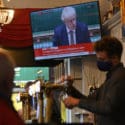
British Prime Minister Boris Johnson has imposed a tiered system of further restrictions on parts of England including shutting pubs, to curb an acceleration in Covid-19 cases, although anger is rising at the cost of the curtailment of freedoms. UK Prime Minister Boris Johnson's speech to the House of Commons screened on a TV in the Richmond Pub, Liverpool. Photo: AFP Johnson announced a new three-tiered system on Monday in an attempt to standardise a patchwork of often complicated and confusing restrictions imposed across England. MPs will vote on the move on Tuesday. The lockdowns will include shutting pubs and bars in areas placed in the "very high" alert level from Wednesday. The other alert levels in the new system are "medium" and "high". So far, Merseyside in northwest England - which includes the city of Liverpool - is the only area classified at the "very high" level. Gyms, leisure centres, casinos, betting shops and adult gaming centres there will also close, Johnson said. "We must act to save lives," Johnson told parliament, adding that he did not want another UK-wide lockdown and that he understood the frustrations of those chafing at the "repressions of liberty". "If we let the virus rip, then the bleak mathematics dictate that we would suffer not only an intolerable death toll from Covid, but we would put such a huge strain on our NHS (National Health Service) with an uncontrolled second spike that our doctors and nurses would simply be unable to devote themselves to other treatments." Health officials say the latest data showed infections were rising across the north of England and in some more southerly areas too, while the virus was creeping up age bands towards the elderly from those aged 16-29 years. A street sign in Liverpool, north west England. Photo: AFP or licensors Manchester intensive care consultant Jane Eddleston said 30 percent of critical care beds were taken up with Covid-19 patients and this was starting to affect healthcare for others. "This is not how we want to live our lives but this is the narrow path we have to tread between the social and economic trauma of a full lockdown and massive human and indeed economic cost of an uncontained epidemic," Johnson said. "The weeks and months ahead will continue to be difficult and will test the mettle of this country," he said. But as millions of people across the United Kingdom grapple with restrictions, the hospitality sector says it is being brought to its knees by the government. Karen Strickland, landlady of The Grapes pub in Liverpool, said their income was already down by 70 percent with the current enforced countrywide closing time of 10pm, and the government's support scheme help was not enough. "It's absolutely horrendous," she said, adding it made no sense to single out pubs. Under the new restrictions, however, pubs that serve a main lunchtime or evening meal will be allowed to stay open, although they will only be able to serve alcohol as part of such a meal. - Reuters
Back To Top